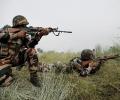
'Both India and Pakistan don't want to escalate tensions.' 'So no matter what is claimed before the public, the reality is slightly different.'

'If this were to happen, it won't exactly be a game changer because Pakistan is known for treating arrested terrorists as 'political prisoners', who are generally given VIP treatment,' says Rajeev Sharma.
'If this were to happen, it won't exactly be a game changer because Pakistan is known for treating arrested terrorists as 'political prisoners', who are generally given VIP treatment,' says Rajeev Sharma.

Even as the United States snuggles closer to India with the thinly veiled objective of containing China, the Indian strategy is to avoid alienating either nation.

External Affairs Minister Sushma Swaraj, who held extensive talks with Egyptian leadership on Monday, proposed to step up exchange of information and coordination to combat terrorism, both at the regional as well as global level
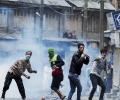
'Burhan Wani's killing served as a spark for the anti-establishment fire that has been raging in the minds of Kashmiris ever since the Centre stopped engaging them for their political future,' says Air Vice Marshal (retd) Kapil Kak in an interview with Rediff.com

'If the situation escalates, then mini-scale firing might happen.'
'New Delhi feels that given the internal dynamics in Pakistan and the overwhelming powers wielded by the army, one will have to wait for better times to see any meaningful progress in the India-Pakistan relationship,' says Ambassador G Parthasarthy.

Condemning terrorism in all its forms and manifestations, US President Barack Obama and Pakistan Prime Minister Nawaz Sharif on Thursday said that no country's territory should be used to destabilise its neighbours.
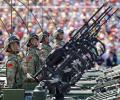
'Whether it is the One Belt One Road project or building relationships in the Indian Ocean Region -- supposedly our area of concern -- the Chinese are seriously outpacing us,' points out Vice-Admiral Premvir Das (retd).

United States recognises that the Indian electorate has weighed in with a resounding mandate for Narendra Modi, and we want to work with the prime minister-designate on advancing his goals for India as a regional and global player, says Gujarat-born US State Department official Nisha Desai Biswal.

Since the 1984 national elections, no party has won a clear majority in the lower house of Parliament, a US intelligence report has observed. Vicky Nanjappa reports.
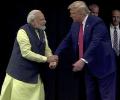
'No amount of digression can hide deflect the fact that the PM's visit was badly conceived, planned and executed,' argues Ambassador M K Bhadrakumar.

New Delhi remains a priggish suitor to Washington's overtures, but it has begun appreciating potential tech benefits to ties with the US.
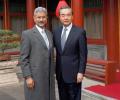
India on Wednesday hit out at China for demanding "solid evidence" for getting Jaish-e-Mohammed chief Masood Azhar banned by the United Nations

In an address at the Raisina Dialogue, Foreign Secretary S Jaishankar took strong objection to the China-Pakistan Economic Corridor which passes through Pakistan-occupied-Kashmir, saying there should have been some reflection on India's unhappiness over it.

French President Francois Hollande indicated on Sunday that the nearly Rs 60,000 crore Rafale jets deal is unlikely to be signed during his current visit although it is on the "right track".
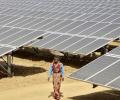
Arunabha Ghosh on why India will increasingly become an energy great power, but not an energy hegemon.

'If you invest your entire capital in talks, you cannot abruptly change gear and decide on war.'
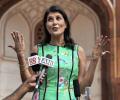
Haley said her India visit aimed at solidifying partnership.

Significantly, reveals Rajeev Sharma, the MEA was not even consulted on the Dolkun Isa issue.

Modi is expected to travel to the US late September.

An MoU on sharing hydrological information of the Brahmaputra River by China to India and another pact on amendment of the protocol on phytosanitary requirements for exporting rice from India to China to include non-Basmati rice were signed after the Modi-Xi talks in the eastern Chinese port city.

When asked if the Indian investigating agency would be allowed to visit Pakistan, Basit said that 'the whole investigation is not about reciprocity in view'.

Pak seeks US help to ease tensions with India.

'It is absolutely critical on pure economic terms, but it's also smart politically, because a recent survey reported that 73 percent of Indians view climate change as the most pressing global concern,' US Secretary of State John Kerry tells a high-power audience in Washington, DC.

'One lesson to emerge out of the Modi-Putin summit is that India can be more self-confident that it possesses inherent strengths to leverage its interlocutors to influence Pakistani policies,' says Ambassador M K Bhadrakumar.

Describing the just concluded United States visit of Prime Minister Narendra Modi as extraordinarily successful, the White House has said that his meeting with President Barack Obama has re-energised the strategic relationship between the two largest democracies of the world.

Chinese President Xi Jinping's visit to India is a time for the two countries to get away from the haze of rhetoric and stale euphoria, says Sana Hashmi.

'The Panchsheel Agreement is unique in the annals of international relations as it stands out as a bizarre illustration of a prime minister trading his country's crucial national interests solely to buffer his personal international image,' feels R N Ravi.

'Both Modi and Xi know that if all that there is to show for Modi's visit -- barely eight months after Xi's India trip -- is a repeat of the same old declarations, there will be a terrible sense of letdown in the public mood resulting in future summits losing credibility. Only the possibility of new ground being broken can justify Modi's trip at this time,' says B S Raghavan.
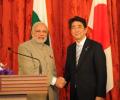
India and Japan are natural partners at sea, and Narendra Modi's recent visit underlined the need to keep the association going
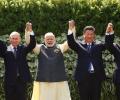
Narendra Modi's success at the BRICS summit is the best Diwali gift for India's diplomacy and marks her ascendancy to global leadership, says Tarun Vijay.

'If the US-Pakistan relationship continues to suffer, Pakistan may feel it has less to lose and decide that it need not keep a leash on LeT in order to appease America.' 'A tougher US policy toward Pakistan could lead to an emboldened and strengthened LeT and JeM, resulting in more terrorist attacks in India.'

When a Chinese warship entered Japanese waters, the Indian commander called on China to maintain discipline at sea. Dr Rajaram Panda explains the significance of the Malabar exercises between India, Japan and the US.

'We are encouraged by what the prime minister said recently on these issues... We will keep a close eye on these issues. They are very important and as are other elements of our human rights and religious freedom.' 'So, absolutely, we'll keep a focus on them.'

Official talks were held between Modi and Seikh Tamim for multi-sectoral partnership and strengthening of Indo-Qatar ties following which the agreements and Memorandums of Understanding were signed on the second day of the Prime Minister's visit.

Prime Minister Narendra Modi and visiting Turkish President Recep Tayyip Erdogan held comprehensive discussions and took stock of full range of bilateral relations, including political and economic.
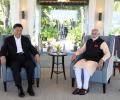
'China physically occupies about 45,000 sq km of J&K as claimed by India, including 3,000 sq km captured in the 1962 War and never returned; and 5,180 sq km ceded to China by Pakistan in 1963.' 'It is hard to justify remaining silent about the return of China occupied Ladakh,' observes Ajay Shukla.

'How can Kashmir be demilitarised if the terrorist threat remains and Pakistan continues to incite elements in Kashmir to keep the internal situation unstable?' asks former foreign secretary Kanwal Sibal.
